A creator economy in four layers
Written, 2024–now · What creators in music and art already had, built for writers
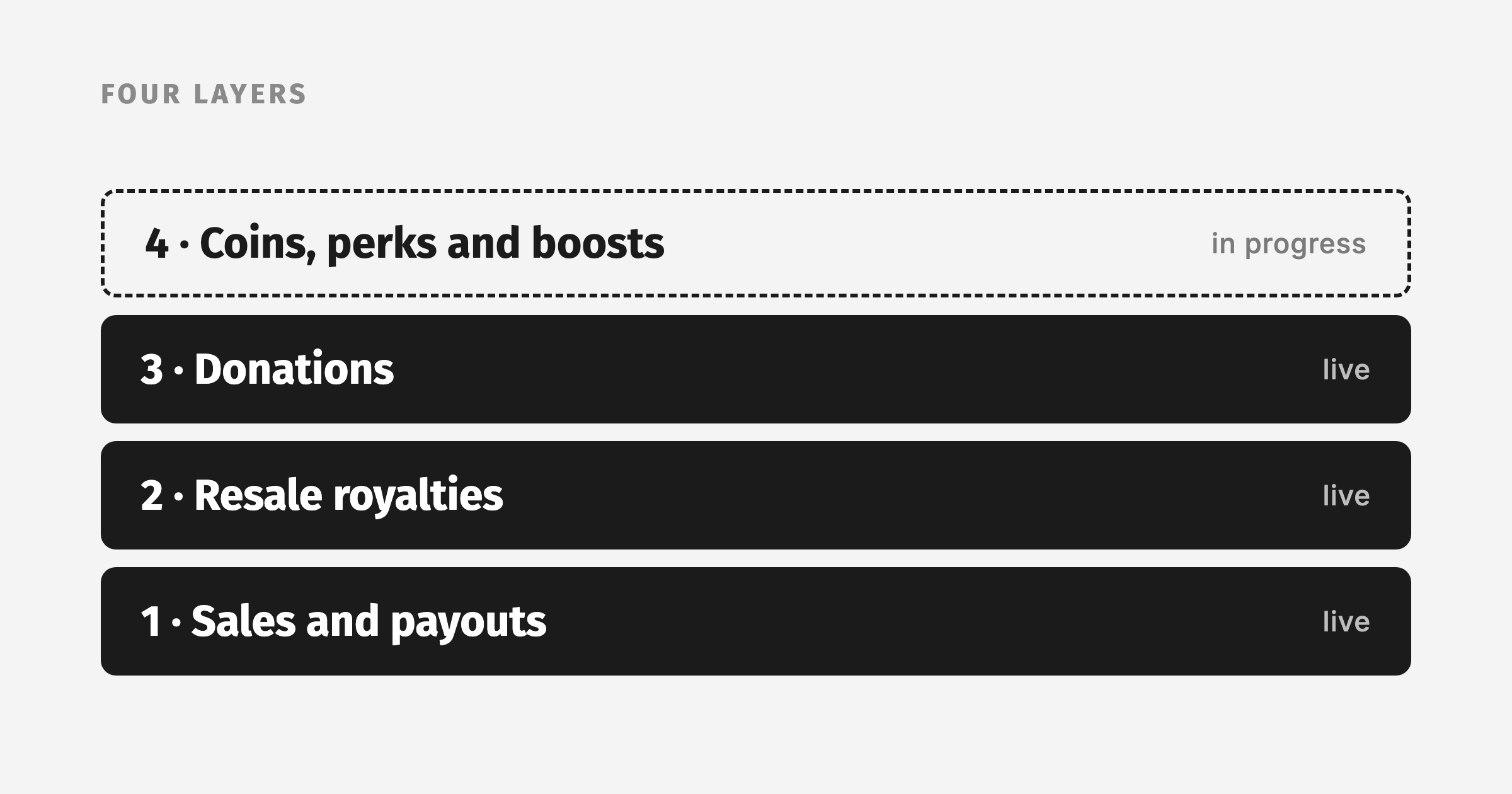
Written is a creator economy reader-to-author platform. Underneath it sits a money system I designed step by step, together with our CTO and engineers, in four layers: sales and payouts, resale royalties, donations and coins. More than $800,000 in sales and resales has gone through it so far. Authors keep up to 90% of every sale, pay nothing upfront, and get paid their way, whenever they want.
The moment
In 2024, Written was two founders who had both come from Bookmate. We knew publishing inside out, and we both believed authors weren’t treated fairly: modest royalties, slow gatekeepers and almost no direct relationship with their readers. Musicians had Bandcamp; artists and podcasters had Patreon and Ko-fi. Writers had nothing quite like it.
We spent hours on late-night calls about what to build. My own passion was a Patreon-like service for authors, but better. We agreed to go step by step.
Four layers, one step at a time
1 · Sales and payouts. I started with research, and a lot of it: hundreds of publishing and creator services, hundreds of self-publishing books and guides (Jane Friedman’s blog among my favorites), how Bandcamp pays musicians, and conversations with authors we knew from Bookmate. We settled on 90% to the author and 10% to us, betting on volume: more authors bring more books, books bring their readers, and readers bring sales.
Then came a surprise. In our first demos, one moderately priced book in 10 copies worked fine, but cheaper books or bigger editions turned the numbers upside down: every transaction on the blockchain costs money. Together with the engineers, we redesigned how editions are created, and publishing a book went from about $10 to under $1, however many copies.
The blockchain also had to stay invisible: to most authors, it sounds like a scam. So readers pay by card through a payment provider, and every author gets a wallet created automatically behind the scenes. We even switched wallet providers after US authors in our Discord told us their one-time passwords never arrived. I chose the providers and wrote the flows and specs.
Getting money in turned out to be easier than getting it out. My payment map showed that readers could pay by card almost anywhere, but authors could withdraw to a bank in only about 60 of 220 countries. With our CTO, I designed two separate money circuits: one in normal money, one in digital dollars, with a bridge between them. Today authors choose: crypto, which works everywhere and costs them nothing; their own merchant account, straight to their bank in local money; or a payout service with an identity check. Any amount, any time, no waiting for the end of a quarter.
2 · Resale royalties. Readers own their books and can resell them, and the author earns 20% of every resale. On most second-hand markets, creators earn nothing.
3 · Donations. Fanfiction authors can’t sell their work, but their readers can support them. The one product decision here: a $50 cap per donation, so it can’t be used for fraud.
4 · Coins. Authors spend coins on perks and boosts: cover generation, audio versions, print and promotion. 50 coins are $1, sold in bundles of $2, $6 and $20. A coin has one price however it’s bought, so I priced every service for the most expensive way to pay, and no path loses money. Coins never expire, and if a third-party service fails, they come back. Coins are in progress.
Keeping it simple on the surface
All this complexity had a way of leaking onto the screen. Our publication page grew into a mess of circuits, providers and fees, so I sat down with our CTO, the product design team and our UX designer, and we rebuilt it as a step-by-step flow (launching in late November 2026). For readers, I made one rule: whatever sits underneath, there is one checkout window. Pick how you like to pay, and don’t think about it.
The hard decision
The rule I held on to through every step: we never take money from an author before they’ve published anything. No fees, no paperwork, no identity checks before the first book is out.
Being honest about the money matters too. The blockchain underneath gives readers real ownership and keeps everything secure, but it has costs. Paid in crypto, the cheapest route, authors keep the full 90%. Paid by card, payment fees and the occasional chargeback come out of their sales, so it’s closer to 85%. Still more than most self-publishing platforms pay, and that’s the “up to” in “up to 90%”.
What happened
- More than $800,000 in sales and resales has gone through the system
- 40k+ users, 18k+ authors, 4.5k+ books on Written
- Live: sales and payouts, resale royalties, donations. Launching: the new publication flow. In progress: coins
What I’d do differently
- Test the extremes before the demos. Next time I’d model the edge cases first, the cheapest book and the biggest edition, before showing anything to anyone
- Design the author’s screens together with the architecture. I’d bring the UX designer in from the first sketch, so the complexity never reaches the screen
- Write down the money rules in one place from day one. One living source of truth for every fee and split, so the team and the authors always see the same numbers, and every document agrees
Why it matters to me
This is game economy design in all but name: a soft currency, bundles, worst-case pricing, and rules people can trust. What I love about it is the shape: complex underneath, simple on top.
Next in the pipeline is my favorite idea, and it takes me back to where I started: readers giving coins to the authors they love, to spend on a new cover or an audio version. A donation, but a targeted one.
And one day, maybe, a DAO: a way for a community to run something together, voting on decisions instead of leaving them all to a company. It’s only an idea for now, not even researched yet, but it’s the one I keep coming back to. Our authors have already changed Written, from the genres and tags we use to the wallet provider we picked. Giving them and their readers a real say would be the natural fifth layer.